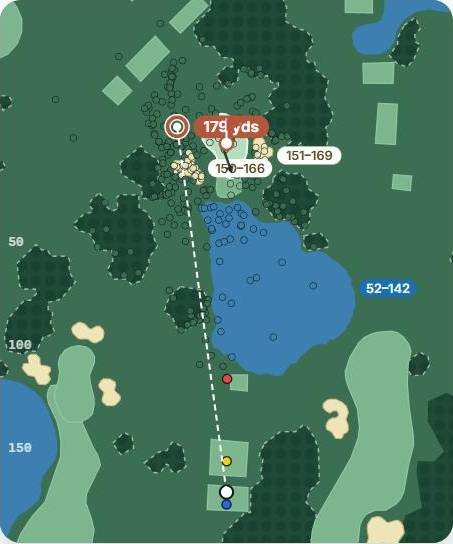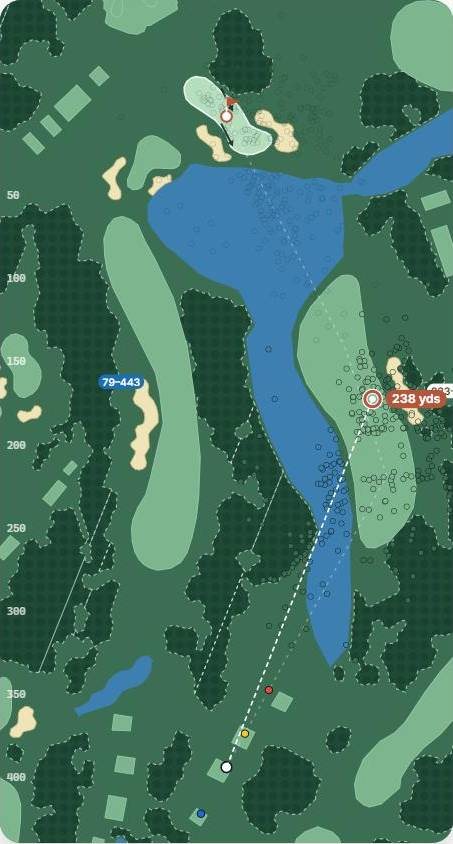
Driver is the club most likely to give you the shortest second shot. It's also the club most likely to find trouble. Whether it's the right club depends on one thing: what's waiting where your bad drives finish.
The simple test
Before you take driver out, ask three questions.
- Where does my normal miss with driver finish? If you slice it, picture the ball 30 yards right of where you aimed.
- Is there water, out of bounds or thick trees there? If yes, a miss costs you a shot or more.
- How much shorter is the second shot with driver? Thirty yards closer usually saves less than you think, about a fifth of a shot for a club golfer.
If a bad driver costs a shot and a good one only saves a fraction of one, take the club you can keep in play.
A real example: the 10th on the Brabazon
The 10th is The Belfry's most famous hole. It's only 301 yards from the white tees, and Seve Ballesteros famously drove the green in 1978. A stream and lake run up the right side and cross in front of the green.
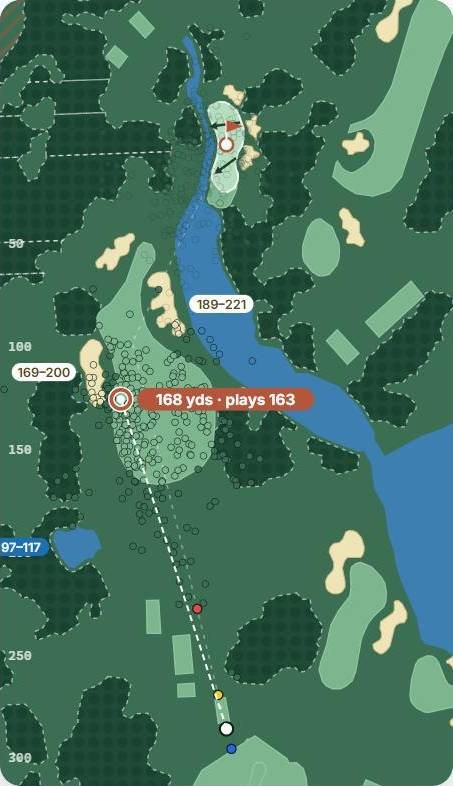
For a 15 handicap, our plan is a 6 iron aimed 12 yards left of the line, to the corner of the dogleg. That finds the fairway about 6 times in 10, and the water only about 1 in 50. Then it's an 8 iron to the green.
With driver, there's nowhere safe to put it. Too straight and the ball runs through the fairway towards the water. A slice finds the water. Even a good one leaves an awkward pitch over the lake.
When driver is the right call
- The landing area is wide, and the trouble is short of where you'll land.
- Your miss finishes in rough, not water or out of bounds.
- It's a long par 4 where a shorter club leaves you a long iron in.
On the Brabazon, our plans still use driver on 14 of the 15 par 4s and par 5s. The 10th is the exception, not the rule.
Check every hole
Bag to Flag tries every club off every tee, simulates your shots and shows you which leaves the lowest score, with the odds of finding the fairway and trouble for each one.